Multidimensional Neighborhood Amenity Characteristics and Housing Prices in Urban China
Published in Applied Spatial Analysis and Policy, 2025
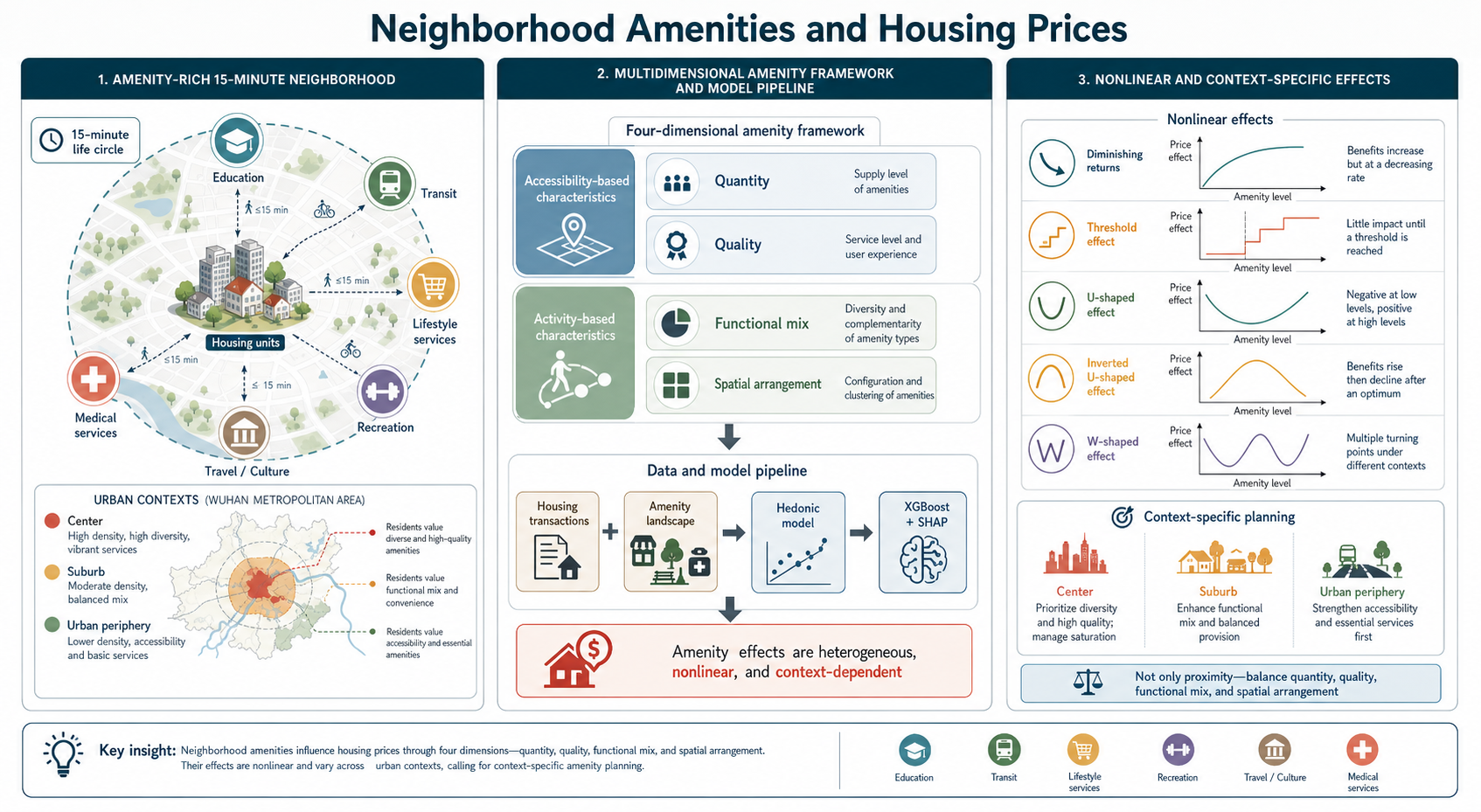
Core contribution: This article moves beyond proximity-based amenity measures by proposing a four-dimensional neighborhood amenity framework: quantity, quality, functional mix, and spatial arrangement. Using Wuhan housing transactions and XGBoost-SHAP interpretation, it reveals nonlinear and context-specific amenity effects on housing prices.
Highlights
- Reconceptualizes neighborhood amenities through both accessibility-based and activity-based characteristics.
- Uses real housing transactions, user-rated amenity quality, and 1-km life-circle measures to capture neighborhood conditions.
- Shows that essential services depend on both quantity and quality, while private services are more sensitive to quality.
- Identifies diminishing returns, threshold effects, U-shaped, inverted U-shaped, and W-shaped patterns that vary across center, suburb, and urban periphery.
核心贡献: 本文突破传统以距离和数量衡量城市设施的思路,提出社区设施的四维分析框架:数量、质量、功能混合与空间组织。基于武汉二手房交易和 XGBoost-SHAP 解释,研究揭示了设施对住房价格的非线性、阈值化和情境差异化影响。
核心亮点
- 从可达性和活动支撑两个维度重新理解社区设施,避免把设施价值简化为“近不近”。
- 结合真实住房交易、用户评分所反映的设施质量,以及 1 公里生活圈指标刻画社区环境。
- 发现教育、交通等基础服务同时依赖数量和质量,而生活、休闲、旅游等私人服务更依赖质量。
- 识别边际递减、阈值、U 型、倒 U 型和 W 型等复杂关系,说明中心区、郊区和城市外围居民的设施偏好并不相同。