How Do Urban Amenities Shape Knowledge-Intensive Industry Locations within Cities? A Multi-Scalar Study of Wuhan, China
Published in Applied Geography, 2025
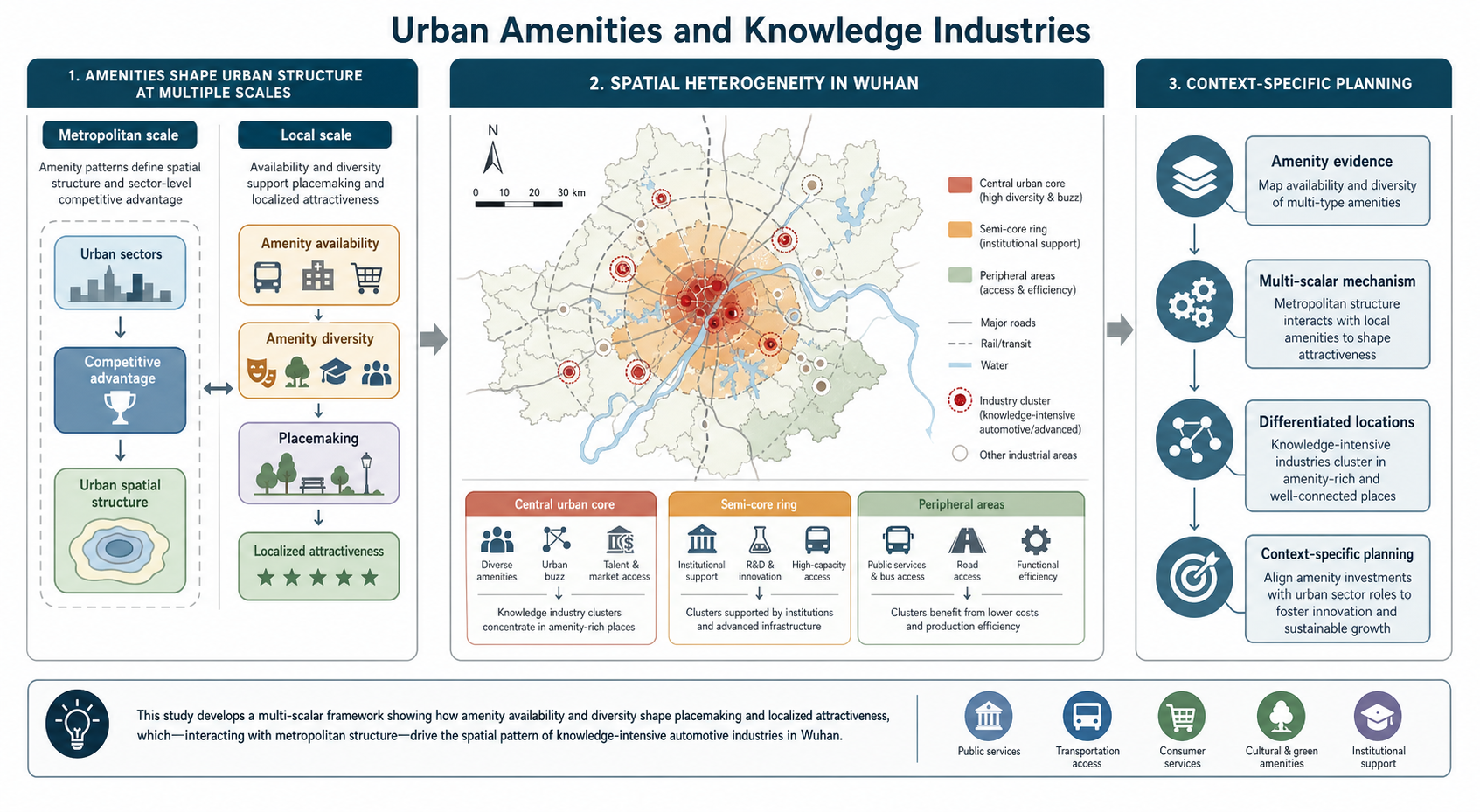
Core contribution: This article develops a multi-scalar framework showing how urban amenities shape knowledge-intensive industry locations: metropolitan amenity patterns organize urban sectors and competitive advantages, while local amenity availability and diversity support placemaking and localized industrial attractiveness.
Highlights
- Builds a two-scale explanation: metropolitan amenity sectors shape competitive advantage, while local amenity diversity supports place-based industrial clustering.
- Shows that automotive firms cluster near high-amenity urban sectors, but local districts still develop specialized industrial clusters.
- Finds that essential infrastructure and public services have more stable effects than consumer amenities.
- Translates the findings into differentiated planning: central districts need innovation buzz, while outer areas need basic services and functional accessibility.
核心贡献: 本文以武汉汽车产业为例,构建多尺度框架解释城市设施如何影响知识密集型产业区位:都市区尺度上的设施格局塑造城市板块与竞争优势,地方尺度上的设施可获得性和多样性则通过地方营造提升产业集聚吸引力。
核心亮点
- 提出两层解释框架:都市区尺度的设施板块塑造竞争优势,地方尺度的设施多样性支撑基于场所的产业集聚。
- 发现汽车企业倾向于靠近高设施水平的城市板块,但地方街区仍会形成具有专业分工的产业集群。
- 指出基础设施和公共服务的影响更稳定,消费型设施并不总是关键。
- 将发现转化为差异化规划建议:中心区需要创新氛围和城市活力,外围地区更需要基础服务与功能可达性。