Institutions, Urban Space, and Residential Markets in Globalizing Shanghai: A Comparative Study of Housing Sale and Rental Prices
Published in Journal of Urban Affairs, 2025
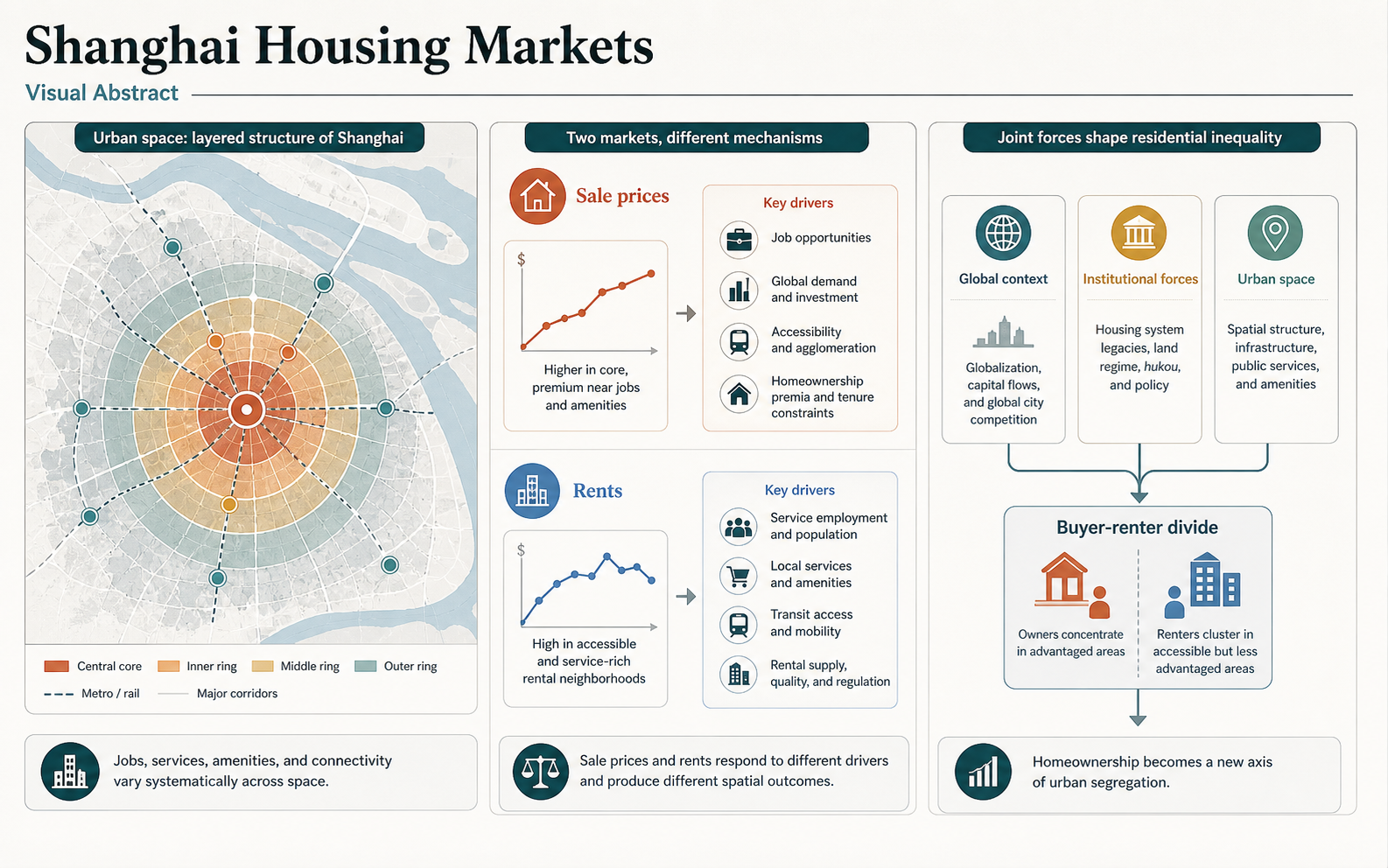
Core contribution: This article compares Shanghai's housing sale and rental markets within one framework, showing that global city forces, institutions, urban space, amenities, and accessibility shape buyers and renters differently and turn homeownership into a new axis of urban inequality.
Highlights
- Builds an integrated framework linking global, metropolitan, and local development contexts to residential market outcomes.
- Uses open housing, amenity, and accessibility data to compare the spatial patterns and determinants of sale prices and rents.
- Shows that renters are more sensitive to job opportunities, social services, and mobility, while buyers place greater weight on service amenities, ownership value, and investment conditions.
- Argues that urban centers intensify exclusion as globalization and institutional advantages concentrate high-end jobs and services.
核心贡献: 本文以上海为案例比较住房销售与租赁市场,将全球化、制度、城市空间、设施与可达性纳入同一分析框架,揭示买房者和租房者的偏好分化,以及以产权和居住身份为核心的新型城市不平等。
核心亮点
- 构建连接全球、都市和地方发展情境的综合分析框架,用来解释住房市场的空间差异。
- 结合开放住房、设施和可达性数据,比较上海住房销售价格和租金的空间格局及其影响机制。
- 发现租房者更受就业机会、社会服务和出行可达性影响,而买房者更重视服务设施、产权价值和投资属性。
- 指出城市中心在全球化和制度优势叠加下集聚高端就业与公共服务,进而强化以产权和居住身份为核心的空间排斥。