Preferences and Barriers of Vulnerable Urban Populations in Affordable Housing in Urban China
Published in Journal of Urban Planning and Development, 2023
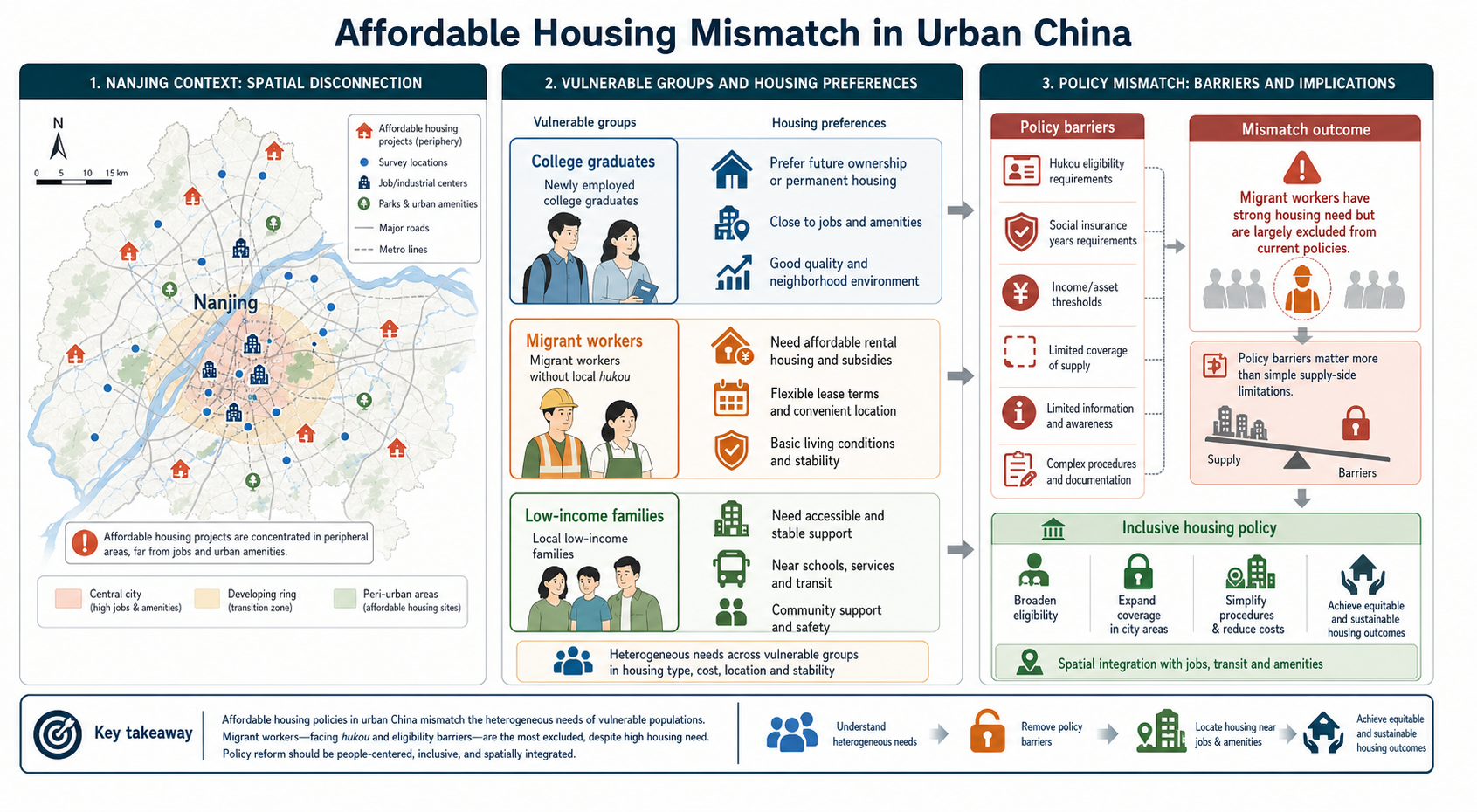
Core contribution: This article examines affordable housing preferences and policy barriers among vulnerable urban populations in Nanjing. It shows that current programs mismatch heterogeneous needs: migrant workers have strong housing needs but are constrained by hukou, social insurance, eligibility, information, and application barriers.
Highlights
- Compares three vulnerable housing groups: newly employed college graduates, migrant workers, and local low-income families.
- Shows that affordable housing projects are often peripheral and disconnected from jobs, services, and urban amenities.
- Finds that policy barriers, including limited information and complicated procedures, are more decisive than supply-side problems alone.
- Calls for inclusive housing policy that broadens eligibility, simplifies procedures, and matches support to heterogeneous population needs.
核心贡献: 本文以南京为案例,比较新就业大学毕业生、外来务工人员和本地低收入家庭的保障性住房偏好与政策障碍。研究指出,现有保障性住房政策与不同脆弱群体的真实需求存在错配,尤其是外来务工人员住房需求强烈,却受到户籍、社保年限、资格门槛、信息获取和申请流程等制度性限制。
核心亮点
- 比较新就业大学毕业生、外来务工人员和本地低收入家庭三类住房脆弱群体。
- 指出保障性住房项目常位于城市外围,与就业机会、公共服务和城市设施存在空间脱节。
- 发现信息不足、申请流程复杂、覆盖范围有限等政策障碍,比单纯供给不足更能解释群体的不满。
- 主张保障性住房政策应扩大覆盖、简化流程,并根据不同群体的实际需求进行差异化支持。