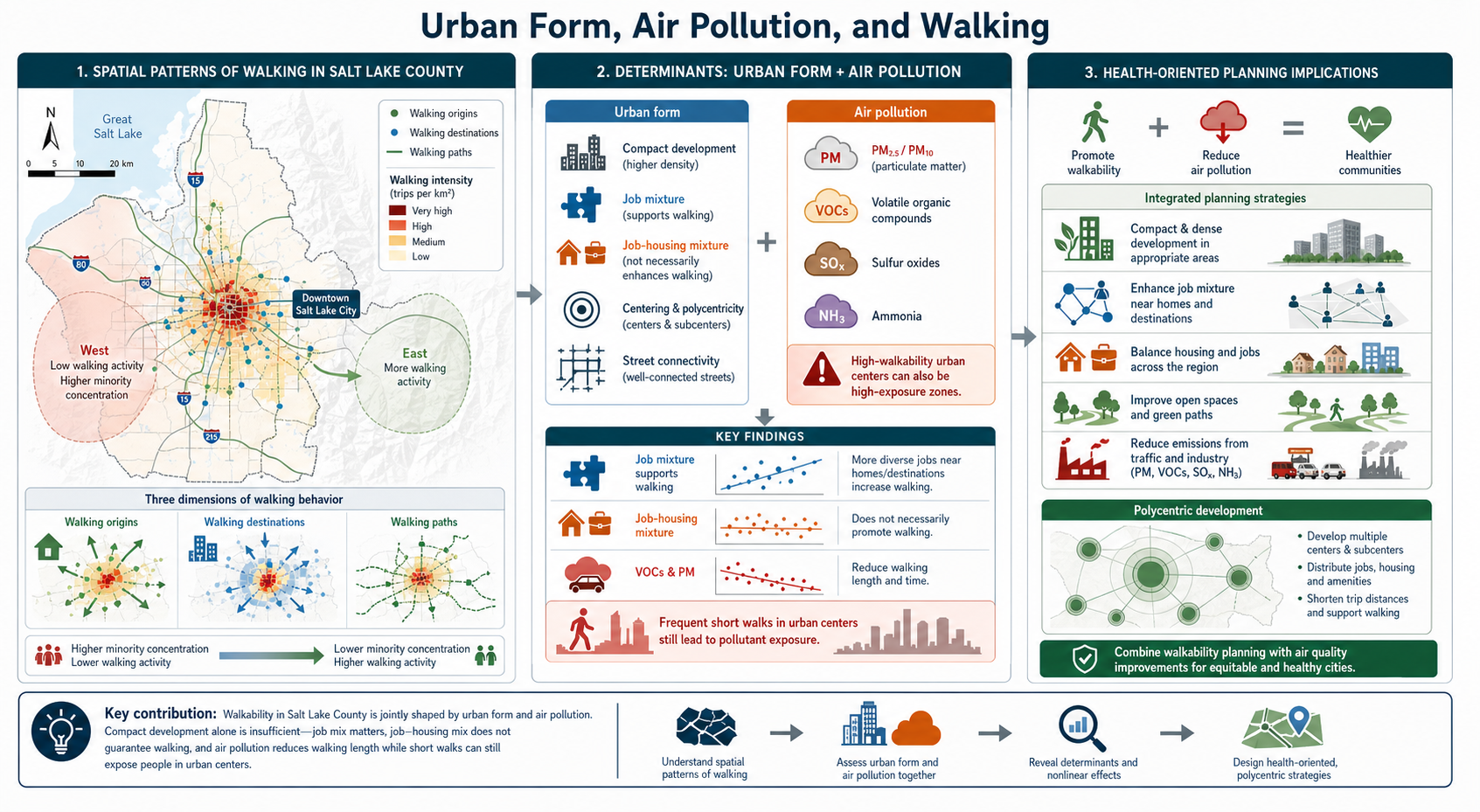
Urban Form, Air Pollution, and Walking Behavior: A Study of Salt Lake County, Utah
Published in Journal of Transport & Health, 2023
Core contribution: This article examines walking origins, destinations, and paths in Salt Lake County to show that walkability is jointly shaped by urban spatial structure and air pollution. It argues that compact development alone is insufficient: healthy walking requires job mixture, pollution reduction, open-space routes, and polycentric development.
Highlights
- Models walking origins, destinations, and paths separately, distinguishing walking frequency from walking duration.
- Shows a strong spatial inequality: downtown and eastern Salt Lake County walk more, while western minority communities walk less.
- Finds that job mixture promotes walking, but job-housing mixture does not automatically translate into more walking.
- Identifies a health trade-off: PM and VOCs shorten walk duration, while frequent short walks in urban centers can still increase pollution exposure.
核心贡献: 本文以盐湖县为案例,将步行起点、终点和路径分开考察,揭示步行性同时受到城市空间结构和空气污染影响。研究指出,单纯提高紧凑度并不足以促进健康步行,还需要优化就业混合、降低污染暴露、改善开放空间路径,并推动多中心发展。
核心亮点
- 分别建模步行起点、终点和路径,并区分步行频次与步行时长。
- 揭示明显的空间不平等:盐湖城市中心和东部地区步行更多,而西部少数族裔社区步行更少。
- 发现就业混合能够促进步行,但职住混合并不必然转化为更多步行活动。
- 指出健康权衡:PM 和 VOCs 会缩短步行时长,但城市中心的高频短距离步行仍可能增加污染暴露。