Regional Drinking Water Supply in Pakistan: Regional Disparity, Inequality, and Development Pattern
Published in The Professional Geographer, 2023
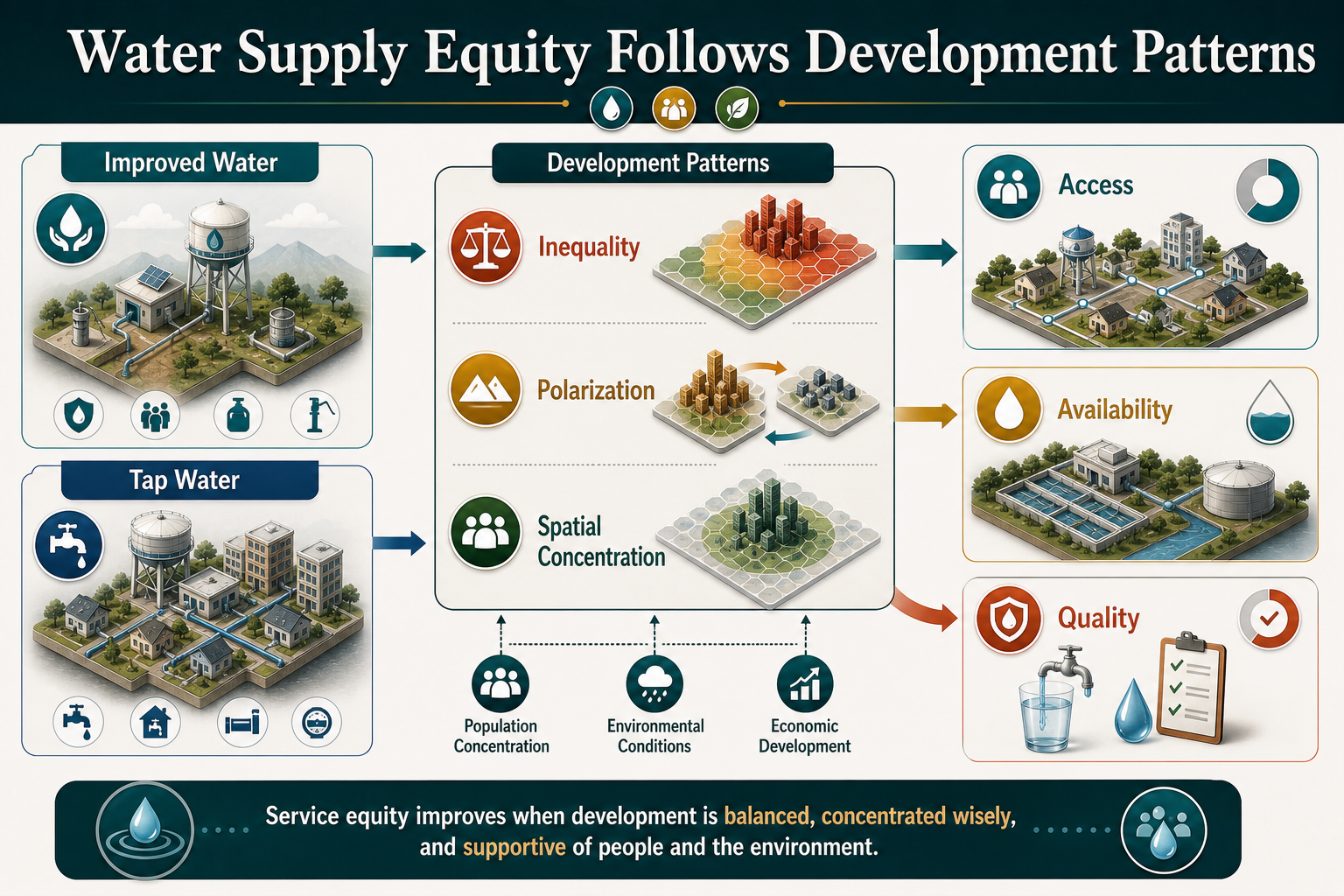
Core contribution: This article treats drinking water supply as a spatial equity problem embedded in regional development patterns. By combining inequality, polarization, and spatial concentration, it shows that improved water and tap water coverage follow different demographic, economic, and environmental mechanisms.
Highlights
- Builds an integrated framework linking water supply coverage with inequality, polarization, and spatial concentration.
- Distinguishes improved water from tap water as different service systems with different mechanisms.
- Shows that population concentration can have contrasting effects on different forms of water coverage.
- Frames water planning around access, availability, and quality rather than coverage alone.
核心贡献: 本文将饮水供给理解为嵌入区域发展格局的空间公平问题。研究结合不平等、极化和空间集中三个维度,说明改良水源和自来水覆盖受到不同的人口、经济与环境机制影响。
核心亮点
- 构建将饮水覆盖与不平等、极化和空间集中联系起来的综合框架。
- 区分改良水源和自来水两类服务系统及其不同机制。
- 指出人口集中可能对不同饮水覆盖形式产生相反影响。
- 强调饮水规划应关注可达性、可获得性和质量,而不只是覆盖率。