Green Infrastructure Inequality in the Context of COVID-19: Taking Parks and Trails as Examples
Published in Urban Forestry & Urban Greening, 2023
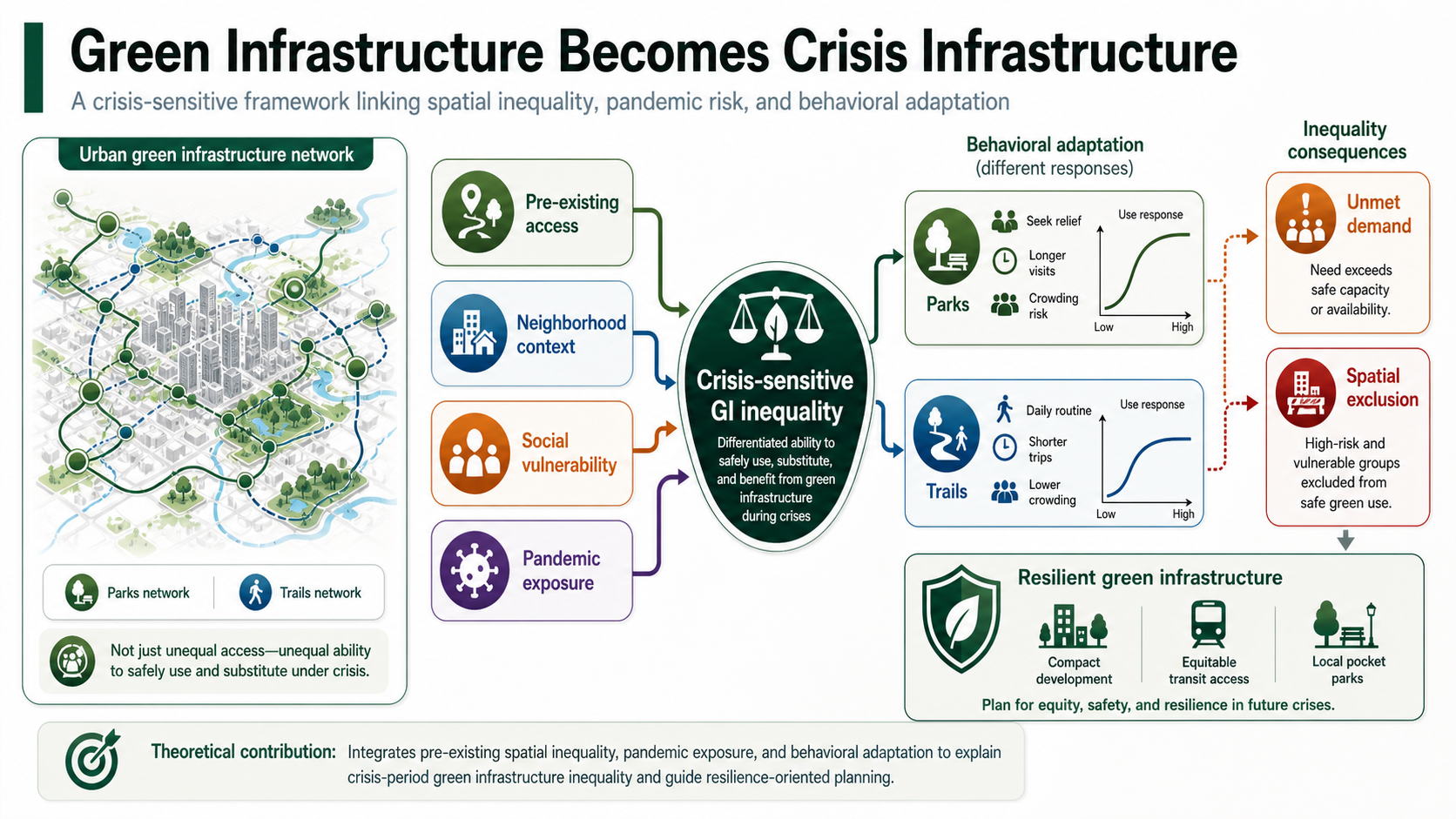
Core contribution: This article reframes parks and trails as crisis infrastructure during COVID-19. It shows that green infrastructure inequality is not only unequal access, but unequal ability to safely use and substitute green spaces under conditions of pandemic exposure, neighborhood vulnerability, and behavioral adaptation.
Highlights
- Builds a crisis-sensitive framework linking pre-existing green-space access, neighborhood context, social vulnerability, pandemic exposure, and behavioral adaptation.
- Distinguishes parks and trails as different green infrastructure systems with different use responses during COVID-19.
- Shows that higher infection risk can increase demand for green infrastructure while vulnerable communities are least able to satisfy that demand.
- Connects green infrastructure equity to resilience planning through compact development, transit access, and local pocket parks.
核心贡献: 本文将疫情期间的公园与步道重新理解为危机基础设施,指出绿色基础设施不平等并不只是空间可达性不均,更是不同社区在疫情风险、社会脆弱性和行为调整约束下,能否安全使用并替代性使用绿色空间的不平等。
核心亮点
- 构建危机情境框架,将既有绿地可达性、社区环境、社会脆弱性、疫情暴露和行为调整联系起来。
- 区分公园与步道两类绿色基础设施,强调它们在疫情期间承载不同的使用响应。
- 指出感染风险上升会提高绿色基础设施需求,但脆弱社区最难满足这种需求。
- 将绿色基础设施公平与韧性规划联系起来,强调紧凑发展、公交可达性和社区口袋公园的重要性。