Analyzing Spatial Heterogeneity of Housing Prices Using Large Datasets
Published in Applied Spatial Analysis and Policy, 2020
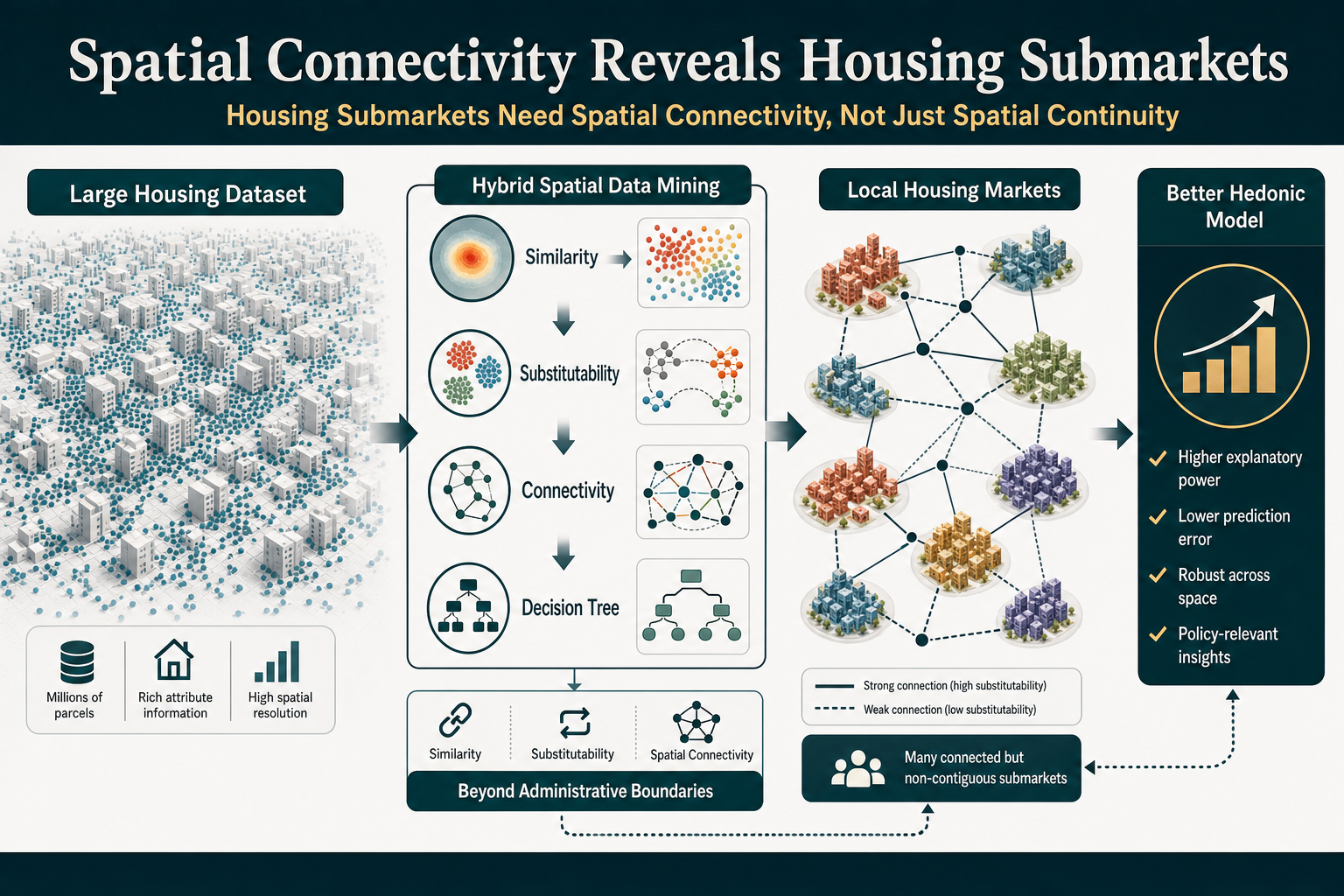
Core contribution: This article advances housing submarket analysis by replacing simple spatial continuity with spatial connectivity. Its hybrid spatial data-mining framework identifies local housing markets through similarity, substitutability, and connectivity, improving both hedonic prediction and theoretical understanding of spatial heterogeneity.
Highlights
- Treats housing submarkets as connected local markets rather than administrative or contiguous zones.
- Combines spatial statistics, clustering, DBSCAN, and decision-tree logic into one feasible workflow.
- Shows that large parcel-level datasets can support theoretically meaningful submarket classification.
- Improves hedonic modeling by aligning prediction with local market structure.
核心贡献: 本文推进了住房子市场研究:它用空间连接性替代简单的空间连续性,将相似性、可替代性和连接性结合起来识别地方住房市场。这一混合空间数据挖掘框架既提升了 hedonic 模型预测,也深化了对住房价格空间异质性的理论理解。
核心亮点
- 把住房子市场理解为相互连接的地方市场,而不是行政边界或连续片区。
- 将空间统计、聚类、DBSCAN 和决策树逻辑整合为可操作的工作流。
- 说明大规模地块级数据可以支持具有理论意义的子市场分类。
- 通过使预测模型贴合地方市场结构,提高 hedonic 模型解释力。