Firm Suburbanization in the Context of Urban Sprawl: Neighborhood Effect and Sectoral Difference
Published in The Professional Geographer, 2020
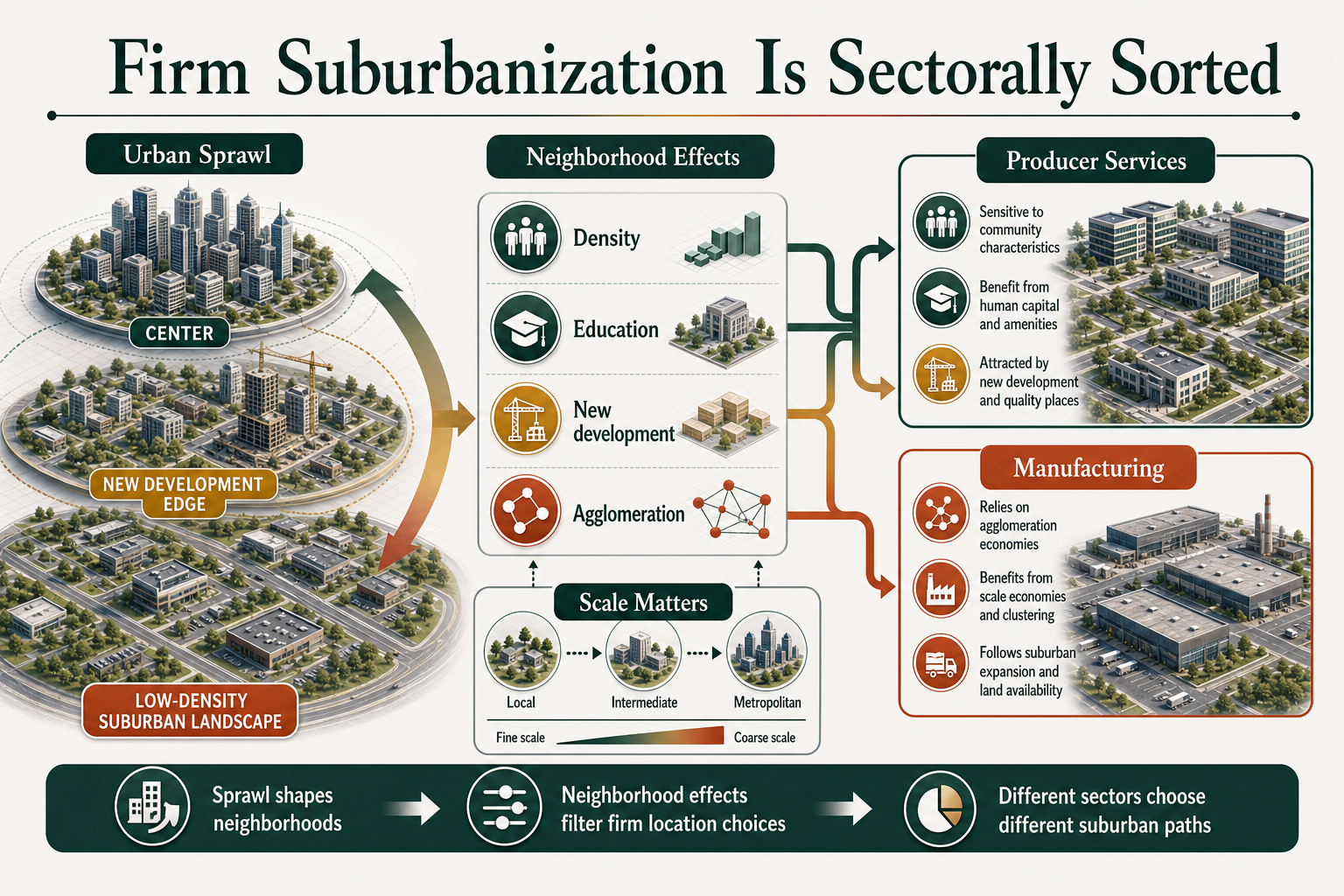
Core contribution: This article reframes firm suburbanization as a sectorally differentiated and scale-dependent process. It shows that producer services and manufacturing respond to different neighborhood mechanisms, challenging the idea that suburban job growth can be explained as a uniform decentralization process.
Highlights
- Links firm suburbanization to urban sprawl, neighborhood context, and sectoral location preferences.
- Shows that producer services are more sensitive to community characteristics than manufacturing.
- Identifies scale-dependent neighborhood effects across block-group and neighborhood levels.
- Argues that producer services should not be treated as one undifferentiated sector.
核心贡献: 本文将企业郊区化重新理解为具有产业差异和尺度依赖的空间过程。研究指出,生产性服务业与制造业对邻里机制的响应不同,从而挑战了把就业郊区化视为统一去中心化过程的传统解释。
核心亮点
- 将企业郊区化与城市蔓延、邻里情境和产业区位偏好联系起来。
- 指出生产性服务业比制造业更容易受到社区特征影响。
- 识别街区组和邻里两个尺度上的差异化邻里效应。
- 强调生产性服务业不能被视为内部无差异的整体部门。