Polycentric Urban Development in China: Dimensions, Effects, and Policies
Published in Chinese Geographical Science, 2025
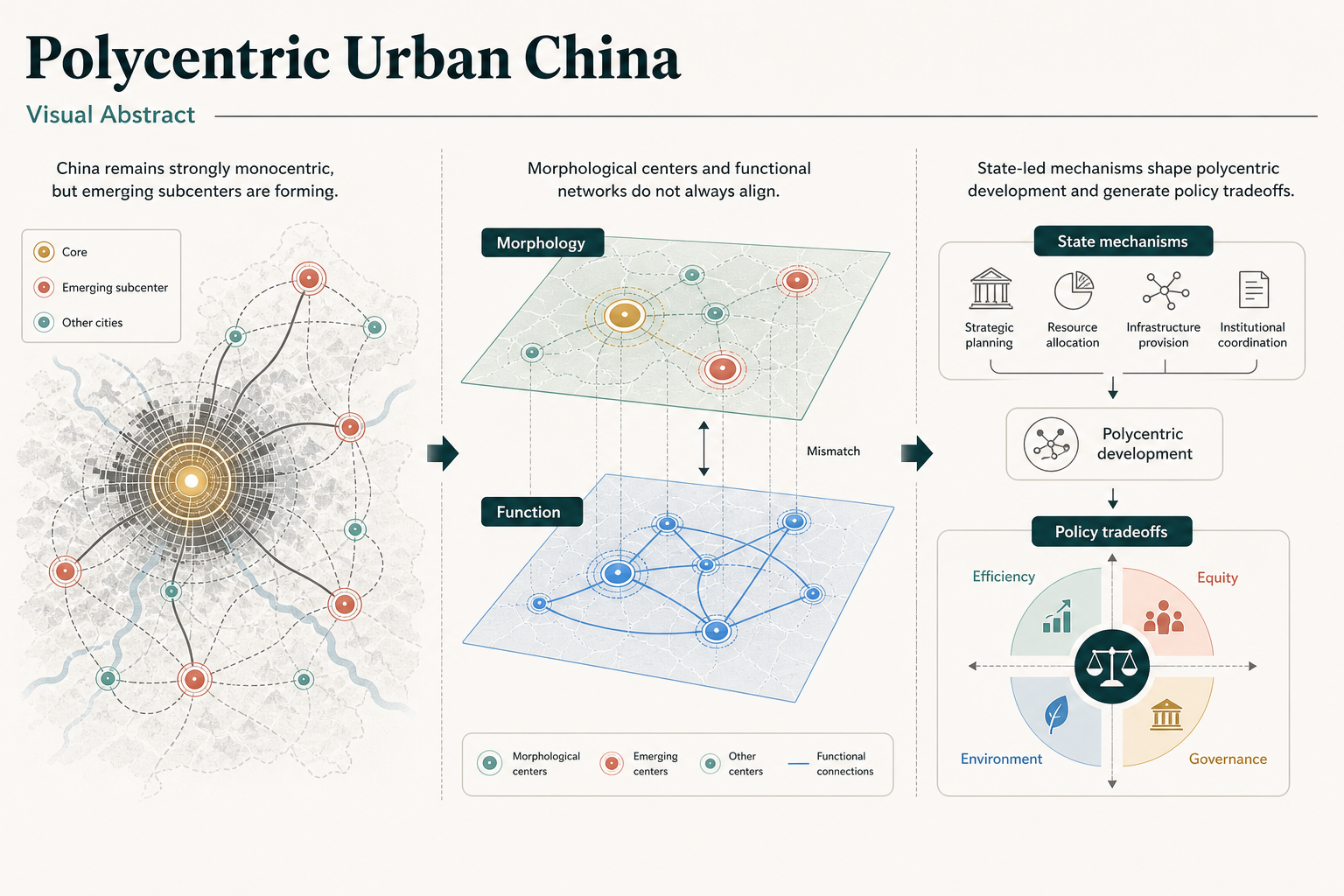
Core contribution: This review reframes polycentric urban development in China through scale, dimension, and mechanism, showing that Chinese urban regions remain largely monocentric while differentiated morphological and functional centers are emerging.
Highlights
- Reviews polycentricity at both intra-urban and inter-city scales.
- Shows that population, employment, housing prices, amenities, and mobility networks often identify different urban centers.
- Highlights the central role of state-led mechanisms, including development zones, new towns, administrative restructuring, high-speed rail, and regional integration policies.
- Treats polycentricity as context-dependent: it may support regional integration and spillovers, but can also lengthen commuting and reinforce core-periphery inequality.
核心贡献: 本文系统梳理中国多中心城市发展的测度、影响与政策机制,指出中国城市区域总体仍以强单中心为主,但正在形成尺度不同、功能不完全匹配的多中心节点。
核心亮点
- 从城市内部和城市群两个尺度,区分形态多中心与功能多中心。
- 指出人口、就业、住房价格、城市设施、交通网络等指标会识别出不同中心,单一指标容易误判城市结构。
- 强调中国多中心发展高度受制度力量影响,包括开发区、新城建设、行政区划调整、高铁和区域一体化政策。
- 对多中心政策保持审慎:它可能促进区域联系和经济溢出,也可能带来通勤增长、公共服务不足和核心-边缘不平衡。