Regional Development and Inequality within City Regions: A Study of the Yangtze River Delta, China
Published in Geographical Review, 2023
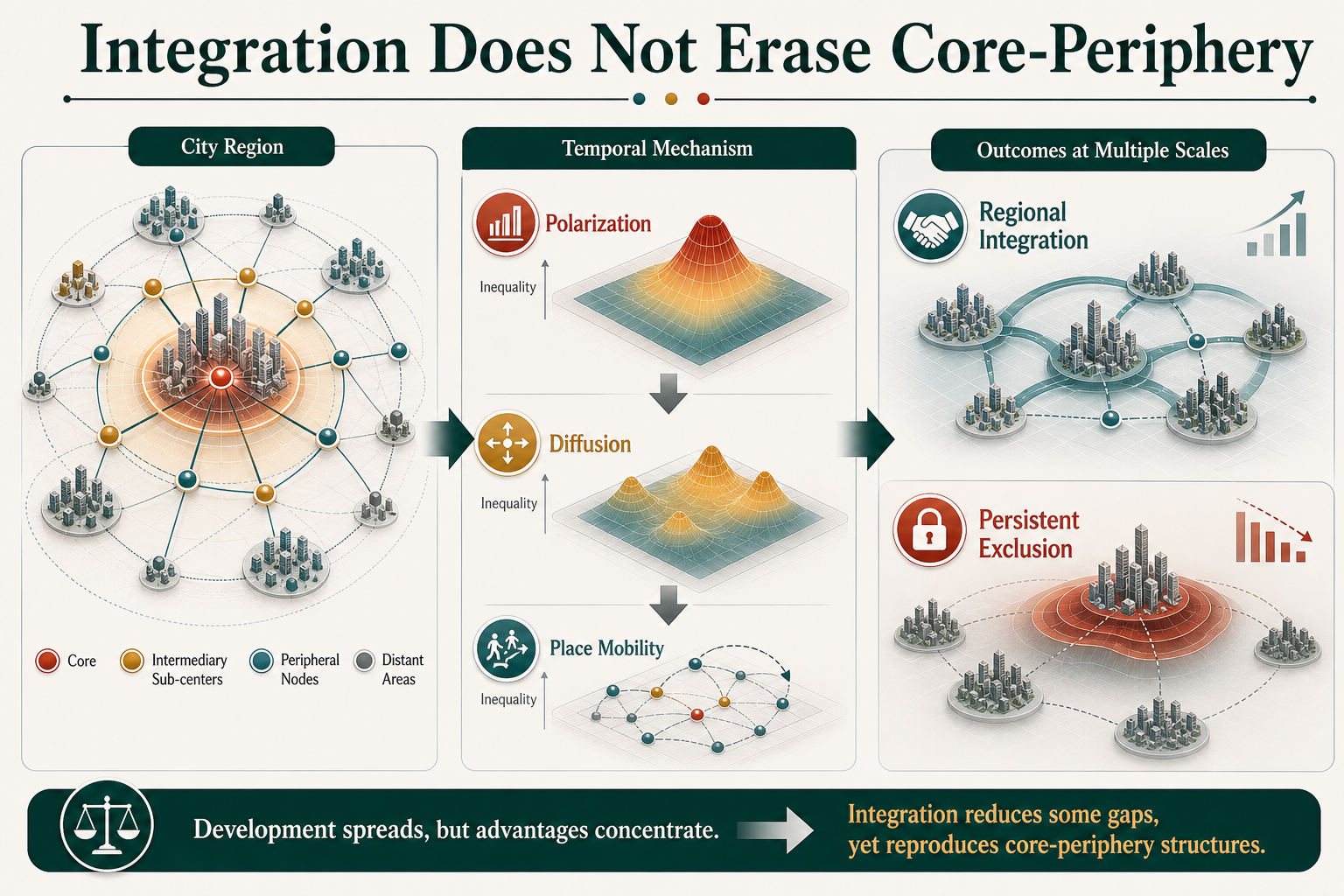
Core contribution: This article complicates the assumption that city-region integration naturally reduces spatial inequality. It shows that polarization, diffusion, and place mobility can operate together, so integration may narrow some gaps while reproducing core-periphery exclusion at other scales.
Highlights
- Frames city-region development as a dynamic relation among polarization, diffusion, and place mobility.
- Shows that regional inequality can decline while core-periphery structures remain institutionally and spatially persistent.
- Connects city-region integration with multi-scalar spatial exclusion.
- Calls attention to peripheral development rather than assuming benefits diffuse automatically from the core.
核心贡献: 本文挑战了“城市区域一体化必然降低空间不平等”的简单假设。研究指出,极化、扩散和地方流动性可能同时发生,因此一体化可以缩小部分差距,也可能在其他尺度上继续再生产核心-边缘排斥。
核心亮点
- 将城市区域发展理解为极化、扩散和地方流动性共同作用的动态过程。
- 指出区域不平等可能下降,但核心-边缘结构仍会在制度和空间上持续存在。
- 把城市区域一体化与多尺度空间排斥联系起来。
- 强调外围地区发展不能被假定为会自动从核心扩散获得。