Trip Generation, Trip Chains and Polycentric Development in Metropolitan USA: A Case Study of the Wasatch Front Region, Utah
Published in Applied Geography, 2021
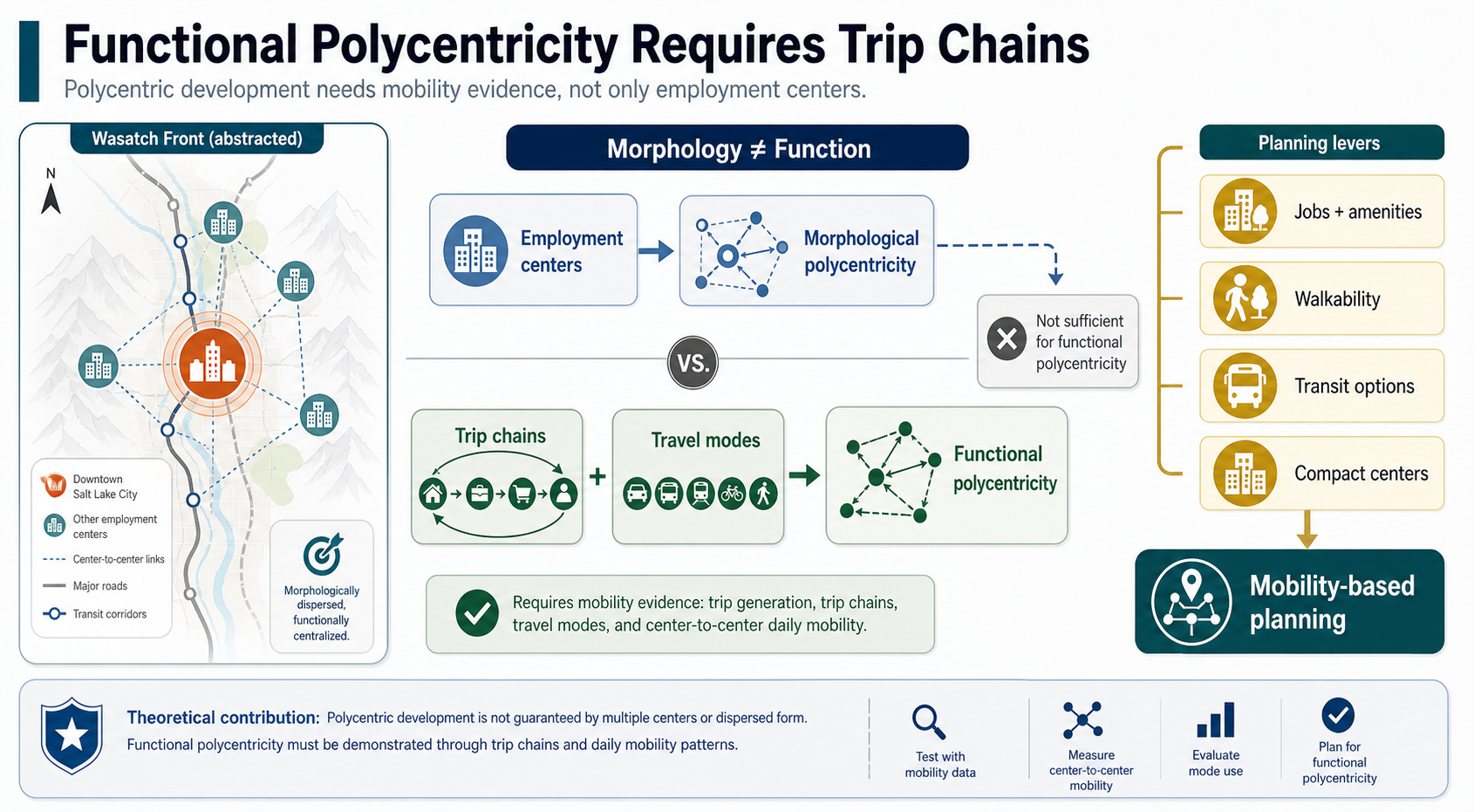
Core contribution: This article distinguishes morphological polycentricity from functional polycentricity. It argues that multiple employment centers or dispersed urban form are not enough: functional polycentricity must be demonstrated through trip generation, trip chains, travel modes, and center-to-center daily mobility.
Highlights
- Uses employment centers and trip-chain behavior to compare morphological and functional polycentricity.
- Shows that the Wasatch Front is morphologically dispersed but remains functionally dominated by downtown Salt Lake City.
- Finds that walking and biking trip chains are common in urban centers, while automobiles dominate outside them.
- Identifies jobs, amenities, walkability, compact centers, and transit options as levers for functional polycentricity.
核心贡献: 本文区分形态多中心与功能多中心,指出多个就业中心或分散化城市形态并不必然带来真正的多中心结构;功能多中心必须通过出行生成、出行链、出行方式和中心间日常流动来验证。
核心亮点
- 结合就业中心和出行链行为,比较形态多中心与功能多中心。
- 发现 Wasatch Front 在形态上较分散,但功能上仍主要受盐湖城市中心支配。
- 指出城市中心内部步行和骑行出行链较常见,而中心外汽车出行仍占主导。
- 将就业、设施、步行性、紧凑中心和公共交通选择识别为提升功能多中心的关键杠杆。