Spatial Analysis of Uneven Metropolitan Development in the Context of Big Data
Published in The University of Utah, 2020
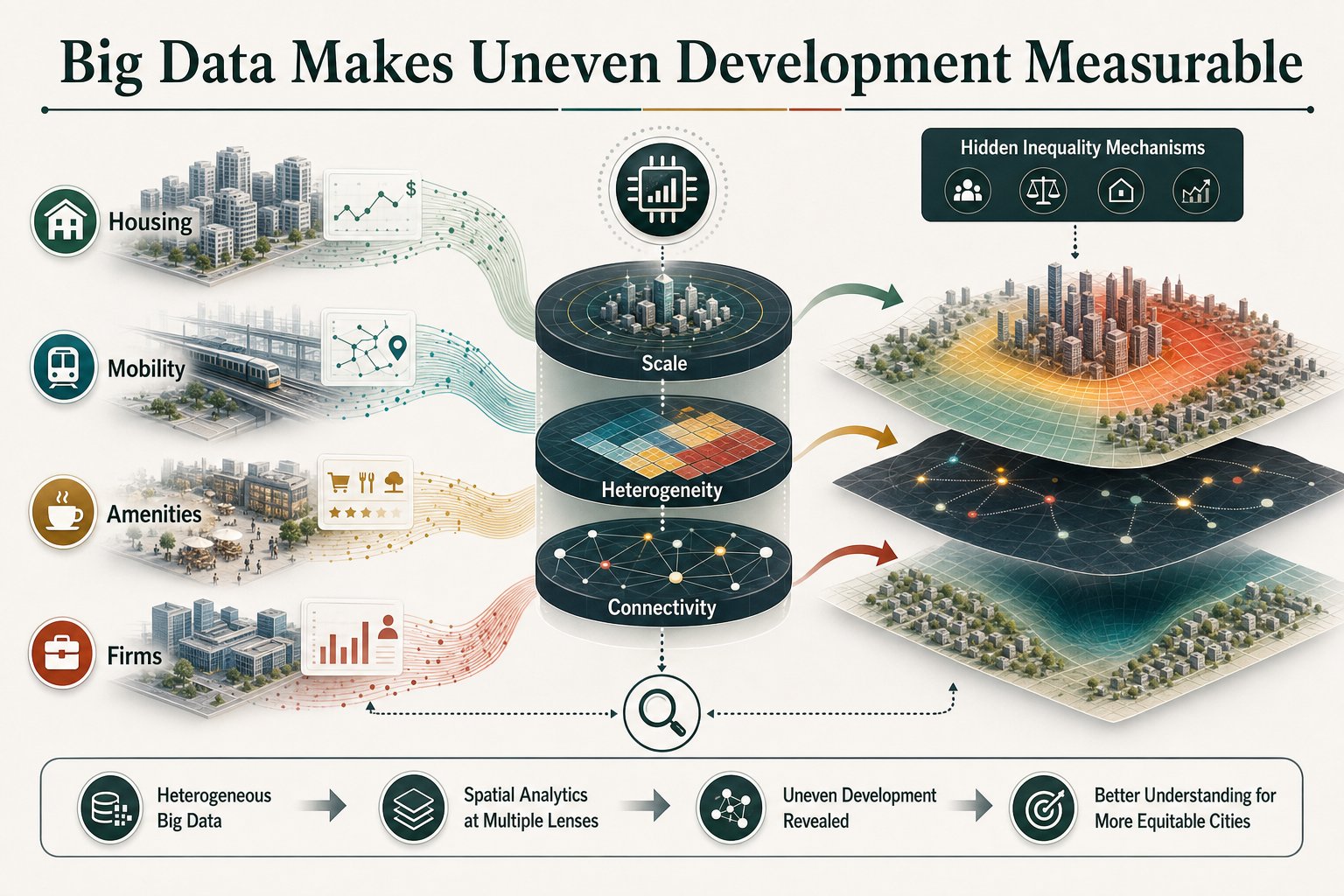
Core contribution: This dissertation frames uneven metropolitan development as a spatial process that can be measured through heterogeneous big data and multi-scale spatial analytics. Its contribution is methodological and conceptual: housing, mobility, amenities, and firms become linked evidence streams for uncovering hidden mechanisms of urban inequality.
Highlights
- Builds a research framework for studying metropolitan unevenness with heterogeneous urban big data.
- Emphasizes scale, spatial heterogeneity, and connectivity as core analytical dimensions.
- Links housing, mobility, amenities, and firm location to broader mechanisms of urban inequality.
- Positions spatial analytics as a way to make hidden metropolitan development processes observable.
核心贡献: 本论文将不均衡都市发展理解为可通过异质性大数据与多尺度空间分析加以识别的空间过程。其贡献既是方法论的,也是概念上的:住房、流动、设施和企业数据共同构成揭示城市不平等隐性机制的证据体系。
核心亮点
- 构建利用异质性城市大数据研究都市不均衡发展的分析框架。
- 强调尺度、空间异质性和连接性是理解不均衡发展的核心维度。
- 将住房、流动、设施和企业区位纳入城市不平等机制的综合解释。
- 把空间分析视为使隐性都市发展过程可观察、可测度的方法路径。