Urban Amenity, Human Capital and Employment Distribution in Shanghai
Published in Habitat International, 2019
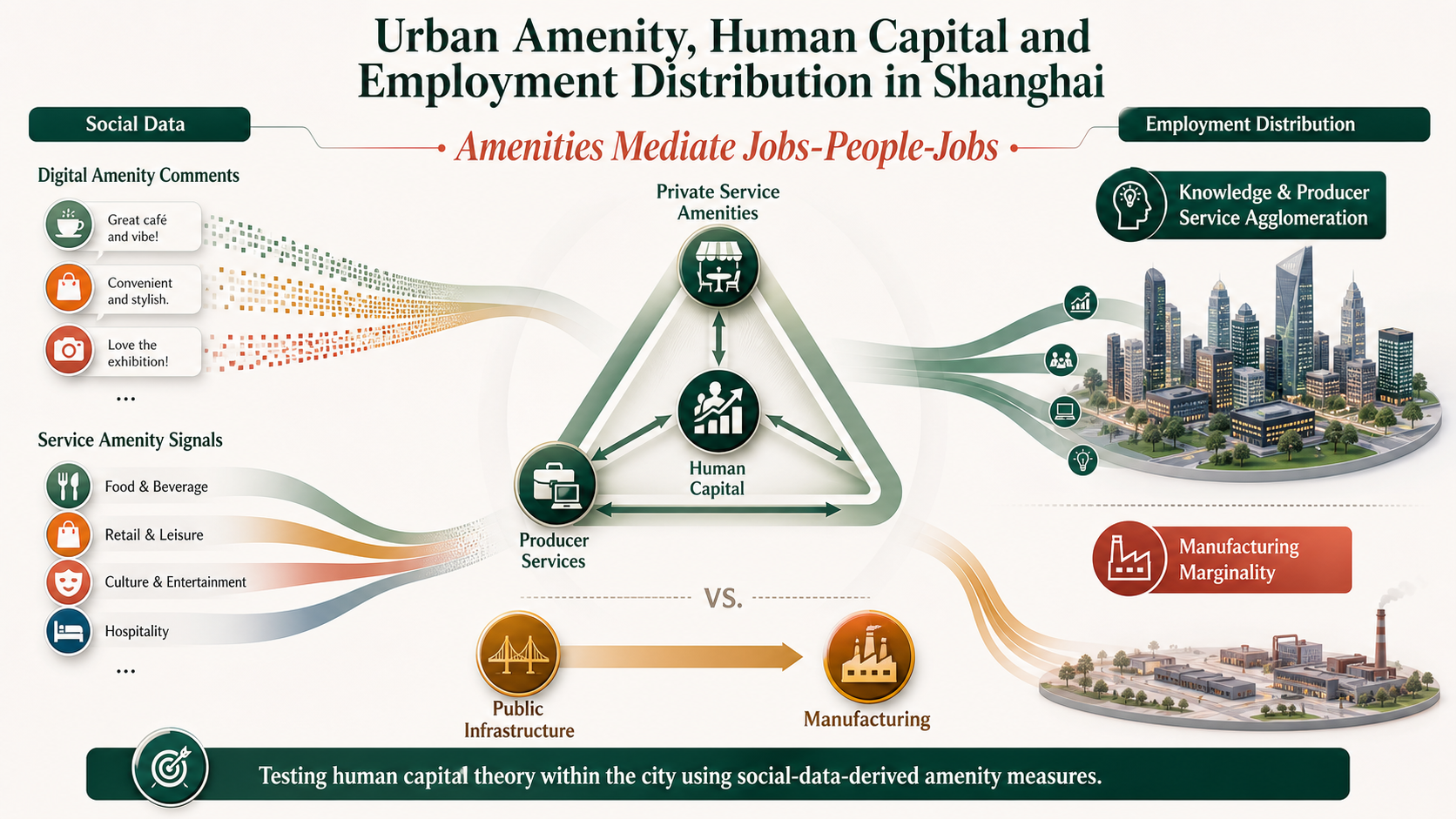
Core contribution: This article uses social-data-derived amenity measures to test the jobs-people-jobs debate within a single metropolis. It argues that amenities mediate employment geography unevenly: private service amenities are tied to human-capital-intensive producer services, while public infrastructure matters more for manufacturing employment.
Highlights
- Turns the jobs-people-jobs debate into an intra-urban empirical question.
- Introduces online review data as a way to measure private service amenities and revealed urban consumption environments.
- Shows that human capital theory applies unevenly across sectors and amenity types.
- Connects service amenity centrality with producer-service agglomeration and manufacturing marginality.
核心贡献: 本文利用社会数据构建设施度量,在单一都市内部检验“就业吸引人口”与“人口吸引就业”的理论争论。研究指出,设施对就业空间的中介作用具有部门差异:私人服务设施更关联人力资本密集型生产性服务业,而公共基础设施对制造业就业更为关键。
核心亮点
- 把“就业-人口-就业”争论推进到城市内部尺度进行检验。
- 利用在线评论数据度量私人服务设施和实际消费环境。
- 指出人力资本理论在不同产业部门和设施类型上的适用性并不相同。
- 将服务设施中心性、生产性服务业集聚和制造业边缘化放在同一解释框架中。