Assessing Urban Park Equity in China through Supply and Demand Balance: A Case Study of Wuhan City, China
Published in Sustainability, 2025
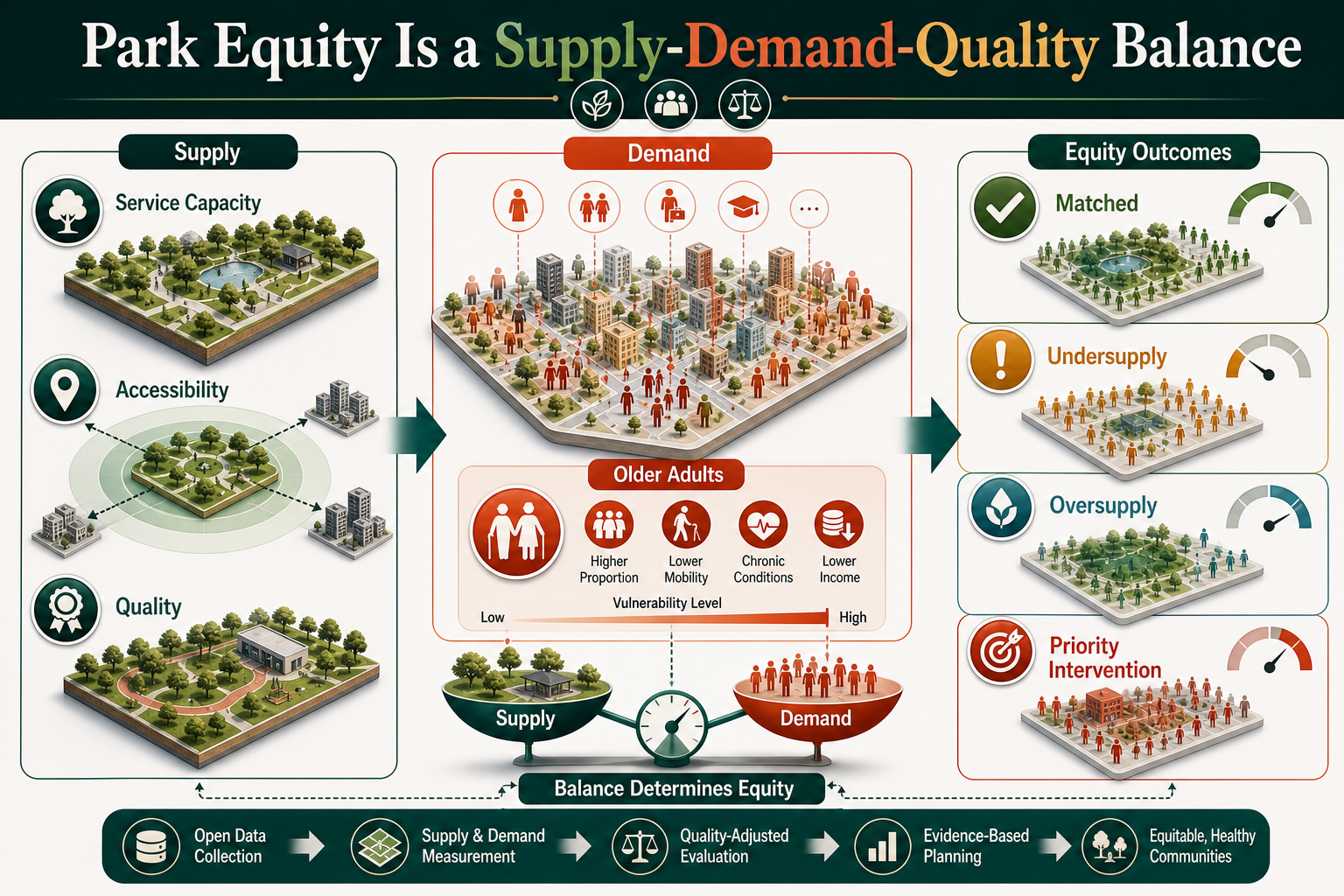
Core contribution: This article conceptualizes urban park equity as a supply-demand-quality balance. It moves beyond access or park area alone by asking whether quality-adjusted park supply matches differentiated population needs, especially the needs of older adults and other vulnerable groups.
Highlights
- Frames park equity as a balance problem rather than a single access metric.
- Combines supply capacity, accessibility, and park quality with heterogeneous demand.
- Highlights older adults as a key vulnerability layer in park equity assessment.
- Supports priority intervention by identifying undersupply and mismatch areas conceptually.
核心贡献: 本文将城市公园公平理解为供给、需求与质量之间的平衡。研究超越单纯可达性或人均面积指标,关注经过质量调整的公园供给是否匹配不同人群需求,尤其是老年人与脆弱群体的真实需求。
核心亮点
- 把公园公平界定为供需平衡问题,而不是单一可达性指标。
- 将供给能力、可达性和公园质量与异质性需求结合起来。
- 把老年人作为公园公平评估中的关键脆弱性维度。
- 通过识别供给不足和错配区域,为优先干预提供依据。