Urban Form and Spatiotemporal Vulnerability of Local Communities to COVID-19
Published in Geographical Review, 2023
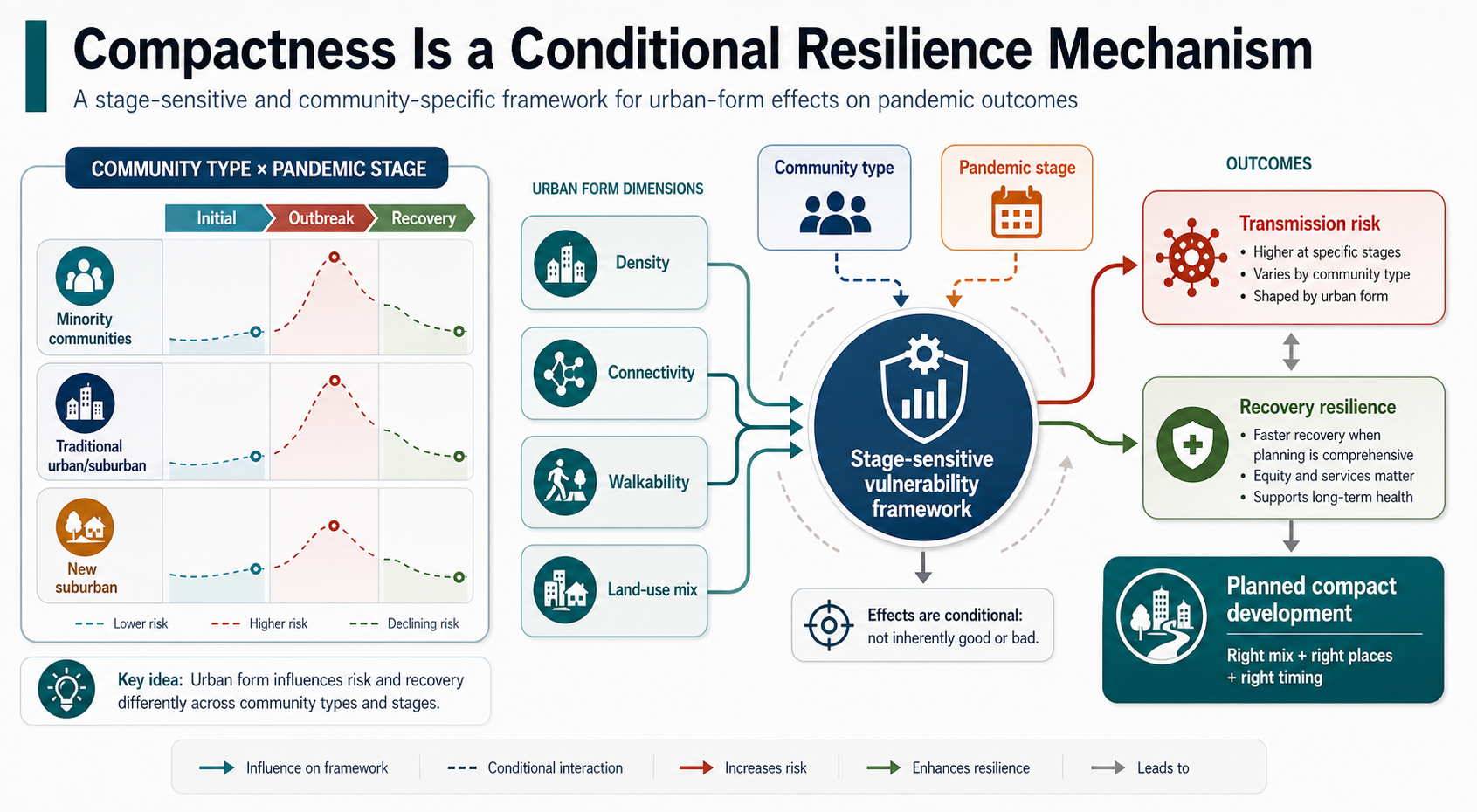
Core contribution: This article challenges a simplistic anti-density reading of COVID-19 by showing that urban form affects pandemic vulnerability differently across community types and pandemic stages. Compact development is not inherently risky or protective: its public-health effect depends on timing, community vulnerability, and the broader planning package.
Highlights
- Develops a stage-sensitive and community-specific framework for understanding urban-form effects on pandemic vulnerability.
- Distinguishes minority, traditional urban/suburban, and new suburban communities across initial, outbreak, and recovery stages.
- Shows that density, connectivity, walkability, and land-use mix can increase risk at particular stages but do not have uniform effects.
- Argues that comprehensive compact development can support recovery resilience when paired with appropriate planning and policy.
核心贡献: 本文反思将疫情风险简单归因于高密度城市的观点,指出城市形态对疫情脆弱性的影响会随社区类型和疫情阶段而变化。紧凑发展本身并非天然有害或天然安全,其公共健康效应取决于时间阶段、社区脆弱性以及更完整的规划组合。
核心亮点
- 提出阶段敏感、社区差异化的框架,用于理解城市形态如何影响疫情脆弱性。
- 区分少数族裔社区、传统城市/郊区社区和新郊区社区,并对应疫情初期、暴发期和恢复期。
- 发现密度、街道连通性、步行性和土地混合会在特定阶段增加风险,但其影响并非一成不变。
- 指出在适当规划和政策配套下,综合紧凑发展仍可支持社区恢复韧性。